
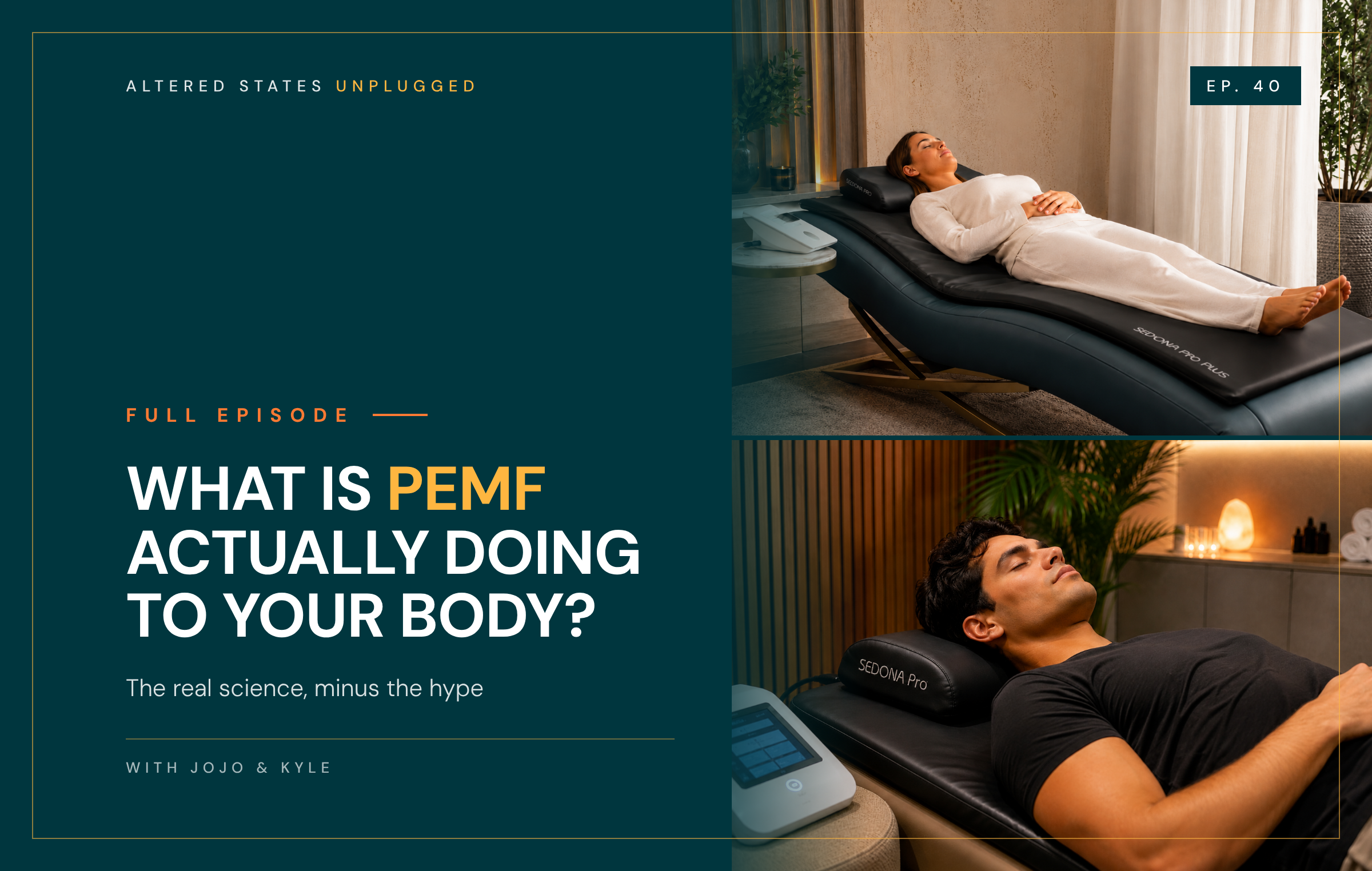
You lie down on a mat. You wait for something to happen. No heat. No pressure. No tingling. Nothing that feels like it's "working."
Then someone tells you electromagnetic fields are interacting with your cells, and your brain quietly files the whole thing under sci-fi.
We get it. PEMF might be the hardest thing in our studios to explain without sounding completely made up. And honestly? A lot of the internet explains it badly. "It charges your cells like a battery" is catchy. It's also not how your body works.
Here's the thing: the real story is way more interesting than the slogan. So in this episode of the Altered States Unplugged Podcast, we went all the way down the rabbit hole. What PEMF is, how something you barely feel can still reach your tissue, what the research actually supports, and where wellness marketing has sprinted way ahead of the science.
What Does PEMF Stand For?
PEMF stands for pulsed electromagnetic field. Let's break that down fast.
- Electromagnetic: run a changing electrical current through a coil and it creates a magnetic field. That coil lives inside the mat.
- Field: nothing has to physically enter your body. The field forms around the coil, and you lie in it.
- Pulsed: the field isn't just left on. It's delivered in repeated pulses, and those pulses can vary a lot in frequency, strength, shape and length.
That last part matters more than people think. Saying "PEMF" is a little like saying "exercise." A five-minute walk and a heavy squat session are both exercise. They are not doing the same thing to your body.
Asking "does PEMF work?" without asking what kind is like asking "does exercise work?" Well... what exercise, how hard, and for what goal?
Your Body Is Already Electrical
This is the part that makes everything else click. Your body isn't powered like a refrigerator, but electrical activity is everywhere in it. Your heart keeps rhythm with electrical signals. Your nerves talk to each other with changes in voltage. Your muscles contract after an electrical signal tells them to.
Every cell has a membrane around it, and there's an electrical difference between the inside and the outside. Think of that membrane like the security system on a building. It isn't just a wall. It has doors, sensors, locks and someone deciding what comes in and what goes out.
Charged particles like sodium, potassium and calcium move through those doors in very controlled ways, and that movement changes what the cell does next. Calcium is a fun one. We think "milk and bones," but inside your cells it's basically the group text: something happens, the message goes out, and everybody knows what to do next.
Your cells aren't tiny batteries waiting to be recharged. But they absolutely use electrical and chemical signals to communicate.
How Does PEMF Work If You Can't Feel It?
Here's the basic physics. A changing magnetic field can create a tiny electric field. That's called electromagnetic induction, and it's the same principle behind your phone's wireless charger. Nothing is plugged in, and energy still moves across the gap.
With PEMF, current moves through the coil in the mat, the coil creates a changing magnetic field, and that field passes through your tissue. Researchers are studying how those very small effects may interact with the electrically sensitive parts of your cells, including how cells pass messages along.
To be clear, this isn't electrocuting you. No current runs through your skin. A better way to think about it: PEMF is less like charging a battery and more like sending a signal.
And about not feeling much? Sensation isn't a requirement for something to happen in your body. You don't feel sunlight kicking off vitamin D production. You don't feel every electrical impulse that keeps your heart beating. Whether your nervous system notices something and whether your cells respond to it are two different questions.
What Does the Research Say About PEMF?
This is the part that surprises people most: PEMF isn't new. Electromagnetic stimulation has been studied in orthopedic medicine for decades, and the FDA recognizes certain prescription bone-growth stimulators that use electromagnetic fields in specific clinical situations. That's a medical device under a doctor's care, not a wellness mat, but it tells you this isn't something the wellness world invented last Tuesday.
Since then, researchers have run human studies on PEMF for joints, everyday aches, recovery and more. Many reviews point in a promising direction. Here's the honest part: the results depend a lot on the setup. Studies use different machines, different frequencies, different session lengths and different schedules, so comparing them gets messy fast.
PEMF research doesn't give us a clean "works" or "doesn't work." It gives us something much more annoying: it depends.
There's also a big difference between levels of evidence. A cell study tells you something can happen. A human trial tells you whether it actually matters for a person. Think of it like testing an engine on a workbench versus putting it in the car and driving it. Both are useful. Only one gets you to work.
PEMF vs. Red Light Therapy vs. TENS
These get lumped together all the time, so here's the quick version.
- PEMF: coils create a pulsing magnetic field. What you feel: usually little to nothing.
- Red light therapy: specific wavelengths of light reach the skin. What you feel: gentle warmth.
- TENS: electrodes on the skin pass a small current. What you feel: tingling.
Yes, light is technically part of the electromagnetic spectrum too. But calling red light and PEMF the same thing is like calling an X-ray and your favorite radio station the same thing. Same giant family. Very different members.
And PEMF isn't the same as TMS, the stronger, targeted magnetic therapy used in medical settings for the brain. Both use magnets. That's where the similarities end.
The Biggest PEMF Myth: "It Charges Your Cells"
You'll see it everywhere. "PEMF recharges your cells like a battery." We understand why it caught on. It's simple and it sounds amazing.
Your cells do hold electrical charge and use electrical signals. But they aren't rechargeable AA batteries. The more accurate (and way cooler) version is that researchers are studying how PEMF may influence the way cells signal and respond to messages your body is already sending.
Same goes for the big universal promises: "detoxes your body," "boosts circulation by X percent," "resets your nervous system," "repairs your whole body." If you see a precise percentage on a wellness claim, ask where it came from.
PEMF doesn't need exaggerated claims to be interesting. The real science is interesting enough.
Why We Offer PEMF Anyway
Full confession: one of us was a hard skeptic. JoJo brought home a PEMF mat, Kyle lay on it for about ten seconds and announced, "This isn't doing anything." It took about a year. Then one day we walked into the studio and found him on the mat. Voluntarily.
We don't offer PEMF because we believe every claim out there. We don't. We offer it because there's real biology behind it, decades of research, a growing body of human studies, and plenty still left to learn. That's a combination we respect.
We'd never position PEMF as "this fixes you." It's one tool. We love it as a recovery add-on, for anyone working on mobility, and as an easy, no-effort first step before a sauna, cold plunge or float. Twenty minutes, zero sweat, and you get to lie down. Not a bad deal.
Wellness doesn't have to be about finding one miracle treatment. Sometimes it's about stacking useful inputs that make it easier for your body to do what it already knows how to do.
What Is PEMF Therapy: The Bottom Line
PEMF isn't magic, and it isn't made up. It's biophysics meeting a body that's already talking to itself through electrical and chemical signals every second you're alive. Science doesn't have every answer yet, but it has enough of them that PEMF deserves to be taken seriously. Not blindly believed. Not wildly overhyped. Understood.
Want the full deep dive, plus the story of how our resident skeptic came around? Listen to Episode 40 of the Altered States Unplugged Podcast above, or on Apple Podcasts, Spotify or YouTube.
For over 8 years, we've helped thousands of people find calm through experiences that make recovery feel like something you get to do, not something you have to earn. More education. Less hype. Always.
Frequently Asked Questions About PEMF
What is PEMF therapy?
PEMF (pulsed electromagnetic field) therapy uses coils, usually inside a mat, to create a pulsing magnetic field around your body. Researchers are studying how those fields may influence the way your cells signal and respond.
How does PEMF work?
A changing magnetic field can create very small electrical effects in tissue, the same physics behind wireless phone charging. Nothing is plugged into you, and no current runs through your skin.
Why can't I feel anything during a PEMF session?
Most PEMF sessions produce little or no sensation. That's normal. Your cells can respond to things your nervous system never consciously notices, like sunlight starting vitamin D production.
Is PEMF the same as red light therapy?
No. Red light therapy uses specific wavelengths of light. PEMF uses pulsing magnetic fields from coils. They're in the same broad electromagnetic family but work very differently, which is why many people enjoy both.
Is PEMF legit or just wellness hype?
Both exist, which is why we did a whole episode on it. Electromagnetic stimulation has been studied in medicine for decades, and human research on PEMF is growing. Some popular claims, like "it charges your cells," go further than the science does.
How long is a PEMF session?
About 20 minutes is common. Many of our guests pair it with a sauna, cold plunge or float cabin session.
Is PEMF safe for everyone?
PEMF isn't recommended for everyone. If you're pregnant or have a pacemaker or other implanted electronic device, skip it. If you have a health condition, check with your doctor first.
Links Mentioned in this Episode:
Subscribe & Review in Apple Podcasts
Are you subscribed to our podcast? If you're not, we want to encourage you to do that today. We don't want you to miss a single episode. Click here to subscribe on Apple Podcasts!
And if you're feeling extra nice today, we'd be really grateful if you left us a review, too. Reviews help other people find the show, and they're fun for us to read. Just click here, select "Ratings and Reviews" and "Write a Review," and tell us your favorite part of the episode. Thank you!
*We are not medical professionals, and the information provided in this blog and podcast is for informational purposes only. Wellness practices mentioned should not be used as a substitute for professional medical advice, diagnosis, or treatment. Always consult with your doctor or a qualified healthcare provider if you have any questions about your health.


